Tokyo to Kyoto via Northern Japan: The new bullet train stations (with Flags!)

It has been a month since the new extension of the bullet train opened from Nagano to the northern coast cities of Toyama and Kanazawa. This means that bullet trains now run from Tokyo directly to these cities and points in between, opening up a new world of possibilities for tourism. If you have a Japan Rail Pass, you will be covered for almost* any of the new bullet train services. Here’s a rundown of the new line and some suggestions for places to visit and itineraries.

The Hokuriku Shinkansen was known as the Nagano Shinkansen when its initial segment opened in October 1997, ahead of the 1998 Nagano Winter Olympics. The new 228 km (141.7 mile) segment opened on March 13, 2015. You can read more about the Hokuriku Shinkansen service classifications by reading my blog post from last October.

Some of the stops along the route:
Flag_of_Iiyama,_Nagano

Iiyama – Located in the northernmost part of Nagano prefecture, Iiyama gets some of the heaviest snowfall in the country. The immediate area east of Iiyama station is clustered with various Buddhist temples, which is why some call it “Little Kyoto.” Generally, Hakutaka services from Tokyo run to Iiyama every 1-2 hours. Information: Shinshu-Iiyama Tourism Bureau

Flag_of_Joetsu,_NiigataJoetsumyoko – This is an interchange station with the Echigo Railway, a private (so-called “third sector”) rail line that JR used to operate trains on until the opening of the bullet train. There is not much to speak of around here, but it should be noted that if you are coming from Kanazawa or Toyama and heading to the coastal city of Niigata, there are a few trains that operate daily between Joetsumyoko and Niigata that are meant to connect with the shinkansen services. This service is called the Shirayuki. The Shirayuki runs to Naoetsu from which it continues to Niigata on JR tracks along the Sea of Japan. Since the first few kilometers are on the Echigo Railway, you will have to pay a 450 yen supplement if you are using a Japan Rail Pass. If you are going from Tokyo to Niigata, use the direct Joetsu Shinkansen instead.
Flag_of_Itoigawa,_NiigataItoigawa – This is the first bullet train stop on the coast as you come north from Tokyo. Itoigawa was named as Japan’s first “Geopark” by the UNESCO-funded Global Geoparks Network, and they proudly boast 24 different areas that you can visit in the region with various mixes of geology, culture and history. Most, but not all, Hakutaka services stop here. More information about the Geoparks can be found at their official website, and they have a wealth of information in English, including updates on which areas are open and closed.

The local JR Oito Line snakes down from Itoigawa towards the south, and you COULD take the scenic, local route all the way down to the castle city of Matsumoto cheaply in 3-4 hours, weather permitting. Nowadays, though, you can do it in about 90 minutes taking the bullet train to Nagano then the Shinano limited express service. Another stop on the Oito Line is Shinano-omachi – a local bus from here will take you to the start of the Tateyama Kurobe Alpine Route, which is open for transit from spring until autumn.

Flag_of_Kurobe,_ToyamaKurobe-Unazuki Onsen – This station is the gateway to one of the most popular hot springs in the area, Unazuki Onsen. To get there, walk to nearby Shin Kurobe Station on the Toyama Chiho Railway (not covered by the Japan Rail Pass) and go to the Unazuki Onsen stop. One of the attractions of Unazuki Onsen is the Kurobe Gorge Railway. Originally built for workers building Kurobe Dam, it operates passenger sightseeing trains from late spring until autumn threading through some stunning mountain scenery.

Flag_of_Toyama,_ToyamaToyama – Our first major stop on the newly-opened bullet train route. The next time I visit Japan and I am able to take the new bullet train line out here, I want FISH… and that’s the main attraction. Toyama is referred to as “Nature’s Fish Tank” because nearby Toyama bay is extremely deep. Yellowtail sushi and sashimi slices from Toyama are said to be among the best in the country.

Many sushi shops in the area participate in the Toyamawan Sushi program, which offers a set course of 10 pieces of freshly-caught sushi for between 2,000 and 3,500 yen. There is also a unique bento box from Toyama that uses fatty trout, called Masunosushi. It is pressed trout over rice, wrapped in bamboo leaves and packed in a wooden box. I was given a used box from a friend in Japan as a gift to take home in my 2004 trip, and even when empty the lovely trout smell lingered for weeks. I would breathe it a few times a day.

ANYWAY, I want to try this box for real on my next visit 🙂

The aforementioned Toyama Chiho Railway terminates here, at the nearby Dentetsu-Toyama Station. This, plus a series of tram lines, are great ways to get around Toyama and visit the cultural areas. Taking the Toyama Chiho Railway to Tateyama will bring you to the opposite end of the Tateyama Kurobe Alpine Route mentioned earlier. More information: Toyama Prefectural Tourism Association
Flag_of_Takaoka_ToyamaShin-Takaoka – This next city has more of a traditional flair. The new station is on the south side of town as opposed to the regular Takaoka station, though the two stations are connected with a brief trip on the JR Johanna line. On the north side of town is Kanaya-machi, a street filled with lattice houses from when iron and copper makers set up shop in the 1600s. A short distance from the south of Takaoka station, and from around the same time period as Kanaya-machi, is Zuiryuji Temple. North of Takaoka and directly on the coast is where weekly ferry services to Vladivostok, Russia operate from.

Flag_of_Kanazawa,_IshikawaKanazawa – The terminating station on the Hokuriku Shinkansen (for now) is a marvel to behold on the outside, with a new main entrance resembling a shinto torii gate. It is a popular city, and the primary reason is Kenroku-en, a large Japanese garden that is regarded as one of the three best in the country. There are also various museums and shopping districts in the area. Kanazawa and Toyama are good starting points for trips to Takayama, and the nearby UNESCO World Heritage site of Shirakawa. More information: Kanazawa City Tourism Association

Of course, Stefan and the folks over at japan-guide.com have a more comprehensive breakdown of what you can find in these cities. They also revamped their website, so be sure to check them out.

After Kanazawa? You can ride the JR Thunderbird limited express to south and west, passing Fukui and skirting Lake Biwa until you reach Kyoto and Osaka. The Shirasagi limited express will bring you to Maibara and Nagoya. If you have already traveled by direct bullet train between Tokyo and Kansai, or you just want something more from your first trip, a little detour through Toyama and Kanazawa (or any of the other places) is a different and potentially rewarding experience.
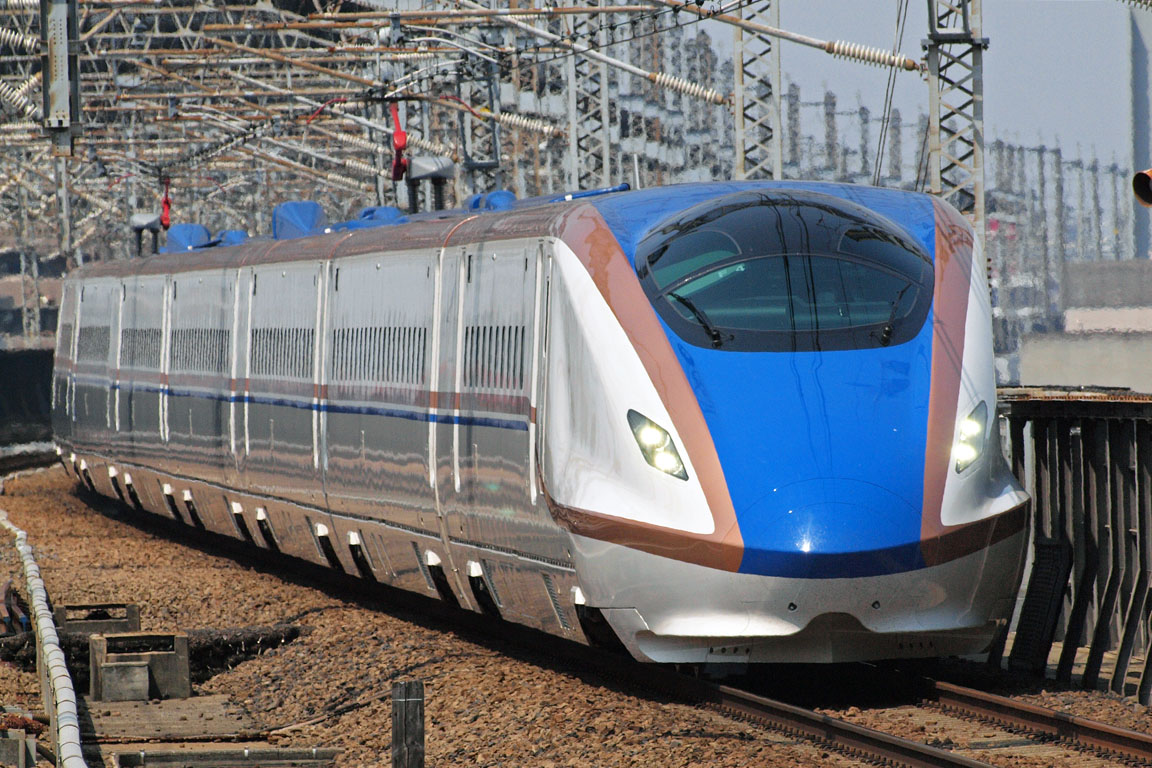
New E7 Series Shinkansen in service. Photo by Tokyo Sakura, CC by 2.0

For example, you could opt to travel from Tokyo to Kanazawa, spend the day there, head to Kyoto in the evening, and then return to Tokyo by direct bullet train. Or you could spend a night at any of these stations if you want to pace yourself a bit… in this way, for example, you could try visiting Kanazawa’s Kenroku-en in the early morning before the tour groups arrive. Whether or not you visit any attractions, you can potentially save some money on accommodations compared to big cities like Tokyo and Kyoto by stopping over at one of these cities. Remember that the Japan Rail Pass will cover pretty much everything for your travels, except for Nozomi trains and for any service with the GranClass premium cabin.

As a general rule, Tokyo to Kanazawa is 2 1/2 hours on the fastest shinkansen service, and Tokyo to Toyama is 2 hours. Kanazawa to Kyoto by Thunderbird limited express service is around 2 hours 15 minutes, with Osaka a further 30 minutes down the line.

I hope I have given you a few ideas. Have fun exploring the new train route and unlocking all of the new secrets along it!

Note: All flags in this article are taken from Wikimedia Commons. Since there is no original ownership they are in the public domain. As per usual, all advice is given pursuant to the Japan Tips DISCLAIMER.

And the fares just keep on falling… under $700 r/t on Delta

Update 4/9/15: Looks like the deals are now gone, and at the current time the below flights can be had for just around $1,000 round-trip.

The amazingly cheap airfares that Delta has maintained on flights to Tokyo, Japan over the last few days are now… ridiculously cheaper. However, as the saying goes, “certain restrictions apply.”

Delta now has cheap airfares from select US cities… most of which have already been mentioned on this blog… connecting to their late-night flights to Haneda Airport. Depending on the arrival and timing, there are more limited travel options out of Haneda in the late night hours compared to an afternoon arrival at Narita, so keep this in mind… unless of course you’re willing to spend night #1 at the hotel inside the terminal 🙂

Delta’s fares connecting to Haneda are now under $700 round trip. Found this morning:

Philadelphia to Tokyo Haneda: $674 round trip.
Charlotte to Tokyo Haneda: $668 round trip.
Miami to Tokyo Haneda: $670 round trip.
Dallas to Tokyo Haneda: $665 round trip.
Phoenix to Tokyo Haneda: $665 round trip.

Yes, these fares to Japan were found from American Airlines hubs.

Flying on Delta, with the exception of Phoenix, you will have to take TWO flights to connect to the Haneda flight out of Seattle. The start of the return trip goes to the US on a Haneda flight to either Seattle or Los Angeles. The fare is good for all Monday-Thursday flights throughout the year, except for some summer dates.

I am wondering if these fare sales are going on because of the US Department of Transportation’s recent ruling concerning the slot, or authority, awarded to Delta for flights between Seattle and Tokyo Haneda. Delta only operated this flight on occasion over the last few months, and while I won’t get into more specifics, the US DOT is requiring that Delta maintain a daily service on this route or else their slot will be forfeited and handed over to… surprise! – American Airlines. Maybe this is a way for them to desperately fill seats on that Seattle to Haneda flight?

In any case, you are the winner. If you’re willing to do a few hops to reach Tokyo, this is a ridiculously low airfare, so go ahead and book while it’s hot!

Low Fares to Japan continue – Sort of

This post is now out of date

Did you bite on those low airfares to Japan that the major US airlines posted a few days ago?

Most of the cheap airfares are now gone… so if you were hoping to fly out of Abilene Airport and fly to Tokyo, you’re now out of luck unless you drive to Dallas.

That’s because a few cheap airfares still remain from a few cities. Given their volatility (availability might be a better word), you will want to pounce on these pretty soon.

While American and United have mostly dropped their sale fares, airfare on Delta Air Lines is still available in the low to mid $800 range from hubs of their competitors. This includes:

Philadelphia (PHL) $820 r/t
Charlotte (CLT) $818 r/t
Miami (MIA) $820 r/t
Dallas (DFW) $820 r/t

From Los Angeles (LAX), several carriers including United, ANA, Delta and Singapore are offering flights for $756 round trip.

If you are in Boston (BOS), United doesn’t want you to fly the nonstop Japan Airlines service to Tokyo. Book with them for spring travel to Japan (connection required) for as low as $771 round trip.

Be sure to check the rules for your airfare as some are now more restrictive on time compared to the previous sale fares.

FARE WAR! Buy your Japan Airfare NOW!

This post is now out of date

In the last 24 hours (since my last airfare post), prices on airfare to Tokyo have dropped significantly from a number of North American destinations. American, Delta and United are now in on the fare war for flights pretty much any time in 2015.

Low fares were found from the following cities – connections may or may not be required

Abilene ABI – $871 r/t
Atlanta ATL – $920 r/t
Boston BOS – $871 r/t
Charlotte CLT – $869 r/t
Chicago O’Hare ORD – $785 r/t
Dallas DFW – $856 r/t
Detroit DTW – $920 r/t
El Paso ELP – $851 r/t
Miami MIA – $862 r/t
Memphis MEM – $915 r/t
Los Angeles LAX – $765 r/t
New Orleans MSY – $989 r/t
Philadelphia PHL – $871 r/t
San Antonio SAT – $871 r/t

There might be more cities on sale… Heck, ABILENE which is only served by ONE AIRLINE in the middle of Texas is on sale for $871 round trip??

I say BOOK NOW. You never know how long these prices will last.

Airfare Alert – $971 R/t on Delta from Dallas to Tokyo

This post is now out of date

Discovered today is a $971 round/trip airfare from Dallas-Ft Worth to Tokyo on Delta Airlines.

The good news about this airfare is that it only requires a 3 day advance purchase. Want to do a spur of the moment trip to Japan? Buy this airfare!

It is also valid for travel until the end of the year, and into early NEXT YEAR, on pretty much any day except for a few dates over the summer. Want to experience a Japan Christmas or New Year? Buy this airfare!

I am not sure how long this fare will be around. A change of planes will be required, but you do have the option to arrive/depart from Tokyo on an afternoon Narita flight or a late night Haneda flight.

If you are from around Dallas and want to experience Japan, book this trip while it lasts! Otherwise you are then looking at around $1,800-$2,000 round/trip for nonstop flights.

Narita Airport to Tokyo – How would you start YOUR Amazing Race?

I was all excited to see that the first leg of my favorite reality TV show, the Amazing Race on CBS, was set in Japan! The theme of this season’s competition is that all of the pairs that are racing are either dating or blind-dating.

The first 90 minute episode, which just concluded, saw teams fly from Los Angeles to Tokyo’s Narita Airport. Interestingly they used Taiwan as a connecting city. I have my reasons for why they planned this to be the case, but this article is not about that!

If you landed in Tokyo’s Narita airport, how would YOU start your Amazing Race in the land of the rising sun?

I have written an article on my blog that explains options for traveling from airports in Japan, which I hope you will look at. But in the meantime, here’s a brief summary of what was featured on The Amazing Race:

Teams pretty much went in one of three ways: Taxi, Skyliner (train), or Narita Express (train). At first I thought to myself, TAXI?! If you are starting your Amazing Race on a budget, the Taxi is the LAST thing that you want to take from Narita. Considering Narita’s large distance away from Tokyo, you would be better off saving money by taking public transport into Tokyo, using the train or bus, then if needed take a Taxi to your final destination. Taxis in Japan are pricey already, but they will be far less expensive to use when you get into the city compared to picking one up at the airport. In addition, Taxis MAY be subject to delays when traveling on the highway… I forgot how each team fared on the way from the airport, so if you want to check, just go to CBS and look at Season 26, Episode 1 of the Amazing Race on demand 🙂

In a nutshell, here is a speed and price comparison for the main travel methods going into Tokyo Station, one of the main transit hubs in the city. By the way… you can get more of Japan by tuning in to the Amazing Race on Friday (February 27) when the teams will visit Nagano!

TRAIN
JR Narita Express, One Hour, 3,020 yen each way

Keisei Skyliner, One Hour (Change at Nippori Station), 2,470 yen for Skyliner + 160 yen JR Yamanote Line = 2,630 yen

Local JR Commuter Train, 90 minutes, 1,320 yen each way

Local Keisei Commuter Train, 90-120 minutes depending on route, ~1,200-1,500 yen depending on route

BUS
Airport Limousine Bus, 1 hour 45 minutes depending on traffic, 3,100 yen each way

Discount Bus to Tokyo Station (Keisei/Be-Transse/JR Bus), 70 minutes depending on traffic, 1,000 yen each way

TAXI
Flat-fare taxi from Narita Airport to Tokyo Station 19,000 yen

Hailed taxi from Narita Airport to Tokyo Station ~20,000-30,000 yen and up depending on the meter and traffic conditions

Airfare Alert! Delta flights to Japan on sale for April and May

This offer appears to have ended (Updated 3/2)

Today Delta Air Lines launched a sale on its flights to Tokyo Haneda – the ones that land and take off during the late night/early morning hours. The fares for flights connecting to these are also discounted.

The Economy airfare on Delta from Los Angeles is $600 round-trip… that’s right, ROUND TRIP, for flights departing and returning on all dates in April and May, except Fridays and Saturdays. Flights from Seattle to Haneda are $680 round-trip for almost the same time frame.

Lowest airfares from connecting cities:

*San Francisco, $615 r/t

*Las Vegas, $615 r/t

*Denver, $782 r/t

*Dallas DFW, $797 r/t

*San Antonio, $841 r/t

*Houston, $913 r/t

*Minneapolis, $931 r/t

*Chicago, $841 r/t

*Orlando, $745 r/t

*Baltimore, $841 r/t

*New York, $745 r/t

*Boston, $942 r/t

Note that you may have to connect once OR TWICE in either direction for the trip. Also, as I’ve mentioned on the blog before, it’s HANEDA. You’ll need to do some research to figure out the best options to/from the airport late in the evening, and you will also want to double check your departure time going back to the US… If it’s a 12:10 AM flight on a Monday, then be sure to show up on Sunday night!

Airfare Alert – Chicago to Japan for $759 round-trip on United Airlines

Discovered today is a discounted airfare from Chicago O’Hare Airport to Tokyo for last minute travel in early March.
The dates for departure and return are extremely limited – either March 3 or March 5 for the departure, and March 7, 12, 14, 21, 24 or 28 for the return.
The flight out to Tokyo leaves Chicago at 1:10 PM. After a connection in San Francisco you arrive at Haneda Airport at 10:30 PM the next day.
The return trip, however, requires you to fly from Haneda Airport to Beijing, China, and after a 5 hour layover, return on United’s nonstop flight from Beijing to Chicago.
A search on the United Airlines website yielded a sample fare of $759 round-trip.
If you prefer to fly nonstop both ways from Chicago, the cheapest nonstop fare is currently $1,115 round-trip on ANA, United, JAL and American.

This fare was checked 2/18/15 10 AM Eastern, subject to change.

Last-minute fare from New York to Tokyo $922 round-trip

012415_EWRNRT

A last minute fare exists on United Airlines for travel from New York to Tokyo, costing just $922 round-trip. It’s a great deal if you want to spend a weekend in Tokyo.

You must depart from Newark Airport on the morning of Wednesday, January 28 and connect in San Francisco, arriving in Haneda Airport at 10:35 PM on Thursday, January 29. You are then free in Tokyo on Friday, Saturday and Sunday before departing early Monday morning, February 2, from Haneda on an All Nippon flight to Hong Kong, connecting after a 6 hour layover to the nonstop United Airlines flight from Hong Kong to Newark Airport. Arrival time back in Newark is 1:50 PM on February 2. You can check up to two bags at no charge for your itinerary.

The information in this post is accurate as of Saturday, January 24, 2015 at 1 PM Eastern Time and is subject to change.

Double American Airlines Miles to/from Japan

Announced this week is a promotion for American Airlines AAdvantage frequent flier members to earn double the normal number of miles on select routes to/from Japan and a few other cities in Asia that are operated by either American Airlines or Japan Airlines. If you are big on frequent flier miles, this is a promotion you may wish to consider.

The offer is valid on all First class, all Business class, and “select” Economy fares on NONSTOP American and Japan Airlines flights between Tokyo Haneda airport and San Francisco, and between Tokyo Narita and the following cities: Chicago (ORD), Dallas (DFW), Los Angeles (LAX), San Diego (SAN), New York (JFK), Boston (BOS), and Vancouver (YVR). Click here to read the full terms and conditions, and to register. You must book and complete all travel by March 21, 2015.

In addition, double miles are being offered on nonstop flights on Japan Airlines from Tokyo to the following Asian cities: Shanghai, Beijing, Guangzhou, Dailan, Jakarta, Hanoi, Singapore and Delhi. Click here to read the full terms and conditions, and to register. You must book and complete all travel by March 20, 2015. Blackout dates are: From Tokyo, February 23-March 1, and returning to Tokyo, February 13-18.

Read the terms and conditions carefully, because the most discounted fares are ineligible for the double miles promotion.

For example, if you wanted to fly from New York to Japan in February (from the 4th to the 11th), I sampled a fare of $1,328 round trip, connecting in Los Angeles on the way to Tokyo and connecting in Chicago on the way back. You’d think you’d earn the double miles on the Los Angeles-Tokyo and Tokyo-Chicago legs, right? But upon closer inspection, the prospective flights would be booked in O and Q classes, which are all ineligible for the double miles offer.

To see what would be eligible, we can go to Google ITA Matrix and search for the fares. Pull up the advance routing codes and enter for both legs of the trip:

AA,JL+ /f bc=s

This forces the matrix to search for any direct flight on AA (American) or JL (Japan Airlines) with the booking code of S, which is the least expensive fare bucket permitted for the double miles.

When we search now, we get a result of $1,704 round-trip, which is for the nonstop from New York to Tokyo on JAL, booked through American Airlines codeshare. Quite a hike from the original $1,328 fare quoted!

If we add an X to the routing codes to look for connecting flights, so that it looks like this:

AA,JL+ X /f bc=s

We then get a $1,696 round-trip fare, connecting in Los Angeles. For that, you might as well pony up $10 for the nonstop!

If the matrix does not come up with any results, you can change the S (in bc=s) to the next letter that is permitted, such as V, L, etc.

It turns out that you CAN book this round-trip on the American Airlines website, and the S fare will show up. In case it does not, however, you might have to give American Airlines a call and ask them to make a reservation that is eligible for the double miles bonus, and hold the reservation. Then you can go online to your AAdvantage account to complete the ticketing. I have read some people that have done this to save on the $25 American Airlines telephone charge, but I’ve never tried this on my own.

In effect, you will be paying extra to secure the double miles. How many miles would you get?

Great Circle Distance of 6,745 miles between New York JFK and Tokyo Narita
x 2 (round-trip) =
13,490 miles
x 2 (Double miles bonus) =
26,980 miles

Congratulations, you just earned yourself a round-trip MilesAAver domestic ticket for one person on American Airlines within the contiguous US and Canada! Essentially, any nonstop AA or JAL flight over 6,250 miles booked accordingly will give you enough miles for the free domestic ticket. Boston, Chicago and Dallas flights are over this number, while flights from the West Coast will leave you a little short.

If you have an American Airlines credit card, you can earn bonus miles from the cost of the airfare… 3,408 miles in the New York-Tokyo example.

Is it worth it to pay the extra to secure the miles bonus? In an era where other airlines are switching miles-earning to a revenue model, which to many is making American Airlines the more frequent-flier airline (failed grammer of the day on that one), this is an offer to seriously consider. Then again, if you are more price-conscious, don’t worry about double miles. Besides, for February 4-11, the cheapest fare is still $1,328 on American. 🙂

As always, I disclaim any responsibility if you decide to do some fare-hunting. Corrections from any savvy travelers out there would be greatly appreciated! The fares in this post are correct as of January 24 2015,12 Noon Eastern Time, and are always subject to change.