
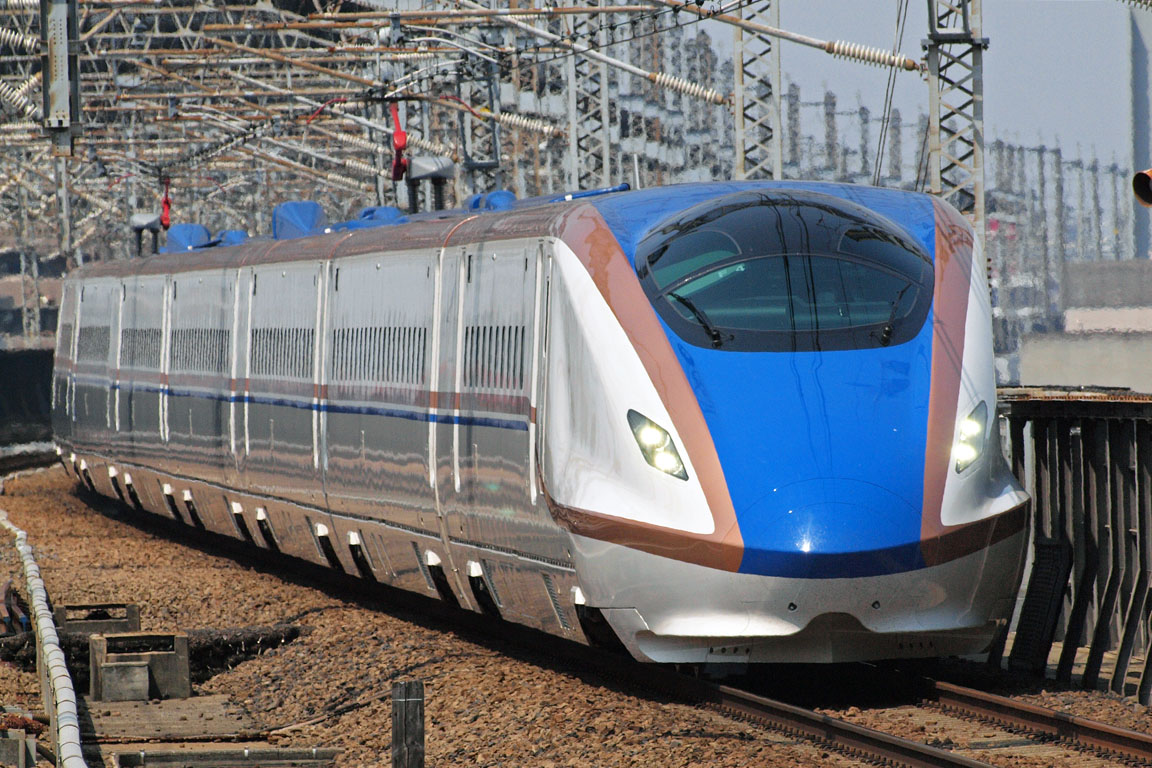
It has been a month since the new extension of the bullet train opened from Nagano to the northern coast cities of Toyama and Kanazawa. This means that bullet trains now run from Tokyo directly to these cities and points in between, opening up a new world of possibilities for tourism. If you have a Japan Rail Pass, you will be covered for almost* any of the new bullet train services. Here’s a rundown of the new line and some suggestions for places to visit and itineraries.
The Hokuriku Shinkansen was known as the Nagano Shinkansen when its initial segment opened in October 1997, ahead of the 1998 Nagano Winter Olympics. The new 228 km (141.7 mile) segment opened on March 13, 2015. You can read more about the Hokuriku Shinkansen service classifications by reading my blog post from last October.
Some of the stops along the route:
Iiyama – Located in the northernmost part of Nagano prefecture, Iiyama gets some of the heaviest snowfall in the country. The immediate area east of Iiyama station is clustered with various Buddhist temples, which is why some call it “Little Kyoto.” Generally, Hakutaka services from Tokyo run to Iiyama every 1-2 hours. Information: Shinshu-Iiyama Tourism Bureau
 Joetsumyoko – This is an interchange station with the Echigo Railway, a private (so-called “third sector”) rail line that JR used to operate trains on until the opening of the bullet train. There is not much to speak of around here, but it should be noted that if you are coming from Kanazawa or Toyama and heading to the coastal city of Niigata, there are a few trains that operate daily between Joetsumyoko and Niigata that are meant to connect with the shinkansen services. This service is called the Shirayuki. The Shirayuki runs to Naoetsu from which it continues to Niigata on JR tracks along the Sea of Japan. Since the first few kilometers are on the Echigo Railway, you will have to pay a 450 yen supplement if you are using a Japan Rail Pass. If you are going from Tokyo to Niigata, use the direct Joetsu Shinkansen instead.
 Itoigawa – This is the first bullet train stop on the coast as you come north from Tokyo. Itoigawa was named as Japan’s first “Geopark” by the UNESCO-funded Global Geoparks Network, and they proudly boast 24 different areas that you can visit in the region with various mixes of geology, culture and history. Most, but not all, Hakutaka services stop here. More information about the Geoparks can be found at their official website, and they have a wealth of information in English, including updates on which areas are open and closed.
The local JR Oito Line snakes down from Itoigawa towards the south, and you COULD take the scenic, local route all the way down to the castle city of Matsumoto cheaply in 3-4 hours, weather permitting. Nowadays, though, you can do it in about 90 minutes taking the bullet train to Nagano then the Shinano limited express service. Another stop on the Oito Line is Shinano-omachi – a local bus from here will take you to the start of the Tateyama Kurobe Alpine Route, which is open for transit from spring until autumn.
 Kurobe-Unazuki Onsen – This station is the gateway to one of the most popular hot springs in the area, Unazuki Onsen. To get there, walk to nearby Shin Kurobe Station on the Toyama Chiho Railway (not covered by the Japan Rail Pass) and go to the Unazuki Onsen stop. One of the attractions of Unazuki Onsen is the Kurobe Gorge Railway. Originally built for workers building Kurobe Dam, it operates passenger sightseeing trains from late spring until autumn threading through some stunning mountain scenery.
 Toyama – Our first major stop on the newly-opened bullet train route. The next time I visit Japan and I am able to take the new bullet train line out here, I want FISH… and that’s the main attraction. Toyama is referred to as “Nature’s Fish Tank” because nearby Toyama bay is extremely deep. Yellowtail sushi and sashimi slices from Toyama are said to be among the best in the country.
Many sushi shops in the area participate in the Toyamawan Sushi program, which offers a set course of 10 pieces of freshly-caught sushi for between 2,000 and 3,500 yen. There is also a unique bento box from Toyama that uses fatty trout, called Masunosushi. It is pressed trout over rice, wrapped in bamboo leaves and packed in a wooden box. I was given a used box from a friend in Japan as a gift to take home in my 2004 trip, and even when empty the lovely trout smell lingered for weeks. I would breathe it a few times a day.
ANYWAY, I want to try this box for real on my next visit 🙂
The aforementioned Toyama Chiho Railway terminates here, at the nearby Dentetsu-Toyama Station. This, plus a series of tram lines, are great ways to get around Toyama and visit the cultural areas. Taking the Toyama Chiho Railway to Tateyama will bring you to the opposite end of the Tateyama Kurobe Alpine Route mentioned earlier. More information: Toyama Prefectural Tourism Association
 Shin-Takaoka – This next city has more of a traditional flair. The new station is on the south side of town as opposed to the regular Takaoka station, though the two stations are connected with a brief trip on the JR Johanna line. On the north side of town is Kanaya-machi, a street filled with lattice houses from when iron and copper makers set up shop in the 1600s. A short distance from the south of Takaoka station, and from around the same time period as Kanaya-machi, is Zuiryuji Temple. North of Takaoka and directly on the coast is where weekly ferry services to Vladivostok, Russia operate from.
 Kanazawa – The terminating station on the Hokuriku Shinkansen (for now) is a marvel to behold on the outside, with a new main entrance resembling a shinto torii gate. It is a popular city, and the primary reason is Kenroku-en, a large Japanese garden that is regarded as one of the three best in the country. There are also various museums and shopping districts in the area. Kanazawa and Toyama are good starting points for trips to Takayama, and the nearby UNESCO World Heritage site of Shirakawa. More information: Kanazawa City Tourism Association
Of course, Stefan and the folks over at japan-guide.com have a more comprehensive breakdown of what you can find in these cities. They also revamped their website, so be sure to check them out.
After Kanazawa? You can ride the JR Thunderbird limited express to south and west, passing Fukui and skirting Lake Biwa until you reach Kyoto and Osaka. The Shirasagi limited express will bring you to Maibara and Nagoya. If you have already traveled by direct bullet train between Tokyo and Kansai, or you just want something more from your first trip, a little detour through Toyama and Kanazawa (or any of the other places) is a different and potentially rewarding experience.
For example, you could opt to travel from Tokyo to Kanazawa, spend the day there, head to Kyoto in the evening, and then return to Tokyo by direct bullet train. Or you could spend a night at any of these stations if you want to pace yourself a bit… in this way, for example, you could try visiting Kanazawa’s Kenroku-en in the early morning before the tour groups arrive. Whether or not you visit any attractions, you can potentially save some money on accommodations compared to big cities like Tokyo and Kyoto by stopping over at one of these cities. Remember that the Japan Rail Pass will cover pretty much everything for your travels, except for Nozomi trains and for any service with the GranClass premium cabin.
As a general rule, Tokyo to Kanazawa is 2 1/2 hours on the fastest shinkansen service, and Tokyo to Toyama is 2 hours. Kanazawa to Kyoto by Thunderbird limited express service is around 2 hours 15 minutes, with Osaka a further 30 minutes down the line.
I hope I have given you a few ideas. Have fun exploring the new train route and unlocking all of the new secrets along it!
Note: All flags in this article are taken from Wikimedia Commons. Since there is no original ownership they are in the public domain. As per usual, all advice is given pursuant to the Japan Tips DISCLAIMER.
 Jose's Japan Tips