This afternoon I came across a press release from the Shinkansen timetable site Tabi-O-Ji, and I thought it might be nice to share here on the blog.
If you want to travel by bullet train in Japan, under most circumstances you cannot book your ticket until you arrive in Japan. There are a few exceptions, most notably the online reservation system of JR East, allowing travelers to reserve – in English – trips on bullet trains that they operate. While many routes to the north are covered, the most important routes – the Tokaido and San’yo Shinkansen connecting Tokyo to Nagoya, Kyoto, Osaka, Hiroshima, Fukuoka and points in between – does not offer advance ticketing in English.
This MIGHT change in the Summer of 2017, when JR Central and JR West are set to unveil a new mobile ticketing system for Tokaido and San’yo Shinkansen trains. According to the press release, you will be able to use the new ticketing system by linking your credit card and an IC card, such as a SUICA, TOICA, ICOCA, etc. You’d have to pick up an IC card in Japan if you don’t have one already, but once you have one you can add it to the account.
Purchases in the new system would be charged to your credit card, then when you are ready to travel you simply tap in and out of the ticket barriers using your IC card.
I bring this up because apparently there is some language in the JR press release saying that “Even foreign travelers can use the system”. This might suggest that in the future, there could be an English option to purchase shinkansen tickets on the Tokaido and San’yo Shinkansen using a mobile device.
There are a few points to note:
– As the release says, you must be in possession of an IC card BEFORE you make a purchase. If you have acquired an IC card from a previous trip to Japan, it is valid for five years after purchase.
– There is no option mentioned regarding purchases for Japan Rail Pass holders. I honestly do not expect such an option to be made available – instead, rail pass holders would have to continue making ticket reservations in person, and pass through manned ticket barriers to access trains.
Further details are yet to be announced (including whether or not there will be an English option) but if you plan to go around on the Tokaido and San’yo Shinkansen using regular tickets, the new mobile ticketing system that will be in place next year might just make purchases easier.
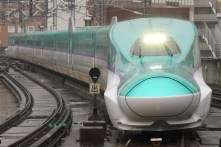
H5 series Shinkansen on a test run. By Sukhoi37, CC BY-SA 4.0
With roughly one month to go until Japan’s iconic bullet train enters the northern island of Hokkaido for the fist time, here’s an important travel advisory for potential visitors to Hokkaido.
Between March 22 and 25, train services from the Japanese mainland to Hokkaido will be shut down in order to make final preparations for bullet train services. This means that during this four-day period, the only way to travel into and out of Hokkaido is by airplane, or by ferry to one of the northernmost ports in Honshu (i.e. Aomori).
The Seikan Tunnel is the long, 33 1/2 mile tunnel connecting Hokkaido with the Japanese mainland under the Tsugaru Strait. Since 1988, passenger trains have made the journey through this tunnel on journeys to and from the southern Hokkaido city of Hakodate. Considering the amount of freight traffic that also uses the tunnel, the Seikan Tunnel is one of the country’s most vital transportation links.
During the four day period that the tunnel is closed, construction crews will make final preparations for the introduction of the new shinkansen services. One of these steps is to raise the overhead voltage into the tunnel from 20 kV to the shinkansen standard of 25 kV.
When the Seikan Tunnel opens to Shinkansen traffic on 26 March, the vital freight services will resume operation. Naturally, JR is on top of things – two years ago, it introduced a new electric locomotive, the EH800, capable of operating at both 20 kV and 25 kV. It will be the sole locomotive hauling freight through the tunnel moving forward.
The opening of the Shinkansen stands to revitalize Hakodate – and in turn, Hokkaido – with new visitors. In the meantime, if you are planning a trip to Japan in the next month, please take note of these dates when the Seikan Tunnel will be closed.
Normally I reserve airfare updates to Japan for my Facebook page, but I thought I would let everyone know here that there is a major price war for flights between the United States and Japan, now involving all three of the major U.S. Carriers: American, Delta and United. Many cities now offer discounted flights to Japan from between $550 and $650 round-trip. Some markets are excluded at the moment (i.e. Atlanta, New York) but do be sure to check out the websites of these airlines to snag your tickets NOW. (That’s my opinion anyway!)
Fares are good for travel for most dates in March and April.
This week, the governments of Japan and the United States reached an agreement with regards to U.S.-based airlines flying into Haneda, the closest airport to Tokyo.
A few years back, U.S. airlines were permitted four daily round-trips from U.S. cities to Haneda, but these flights were restricted to evening hours, when the airport is not busy… and close to the times that public transportation options become limited. This could have proved to be a headache, as I suggested back in 2011, though the opening of a hotel within Haneda’s International terminal in 2014 eased the travel worries somewhat.
Under the new agreement, however, U.S. airlines will be permitted to land at Haneda during regular daytime hours. The slots will change from four round-trips during the night hours to five round-trips during the day, and one round-trip during the evening. The changes will be implemented as early as this coming autumn.
This is tremendous news for travelers between the United States and Japan, as you can now enjoy all of the amenities that Haneda has to offer, while being able to travel into Tokyo quickly and cheaply by train or monorail.
Two of the three major U.S. airlines – American and United – support this agreement. Delta Air Lines, on the other hand, opposes it. Delta feels that the slot change at Haneda to permit more U.S. arrivals during the daytime could compromise its hub operations at Narita Airport and put its U.S.-Japan flights into jeopardy, since travelers would prefer to land at Haneda.
One other aspect that tilts against Delta is the fact that American and United have partners in Japan: American partners with Japan Airlines in the Oneworld alliance, and United partners with All Nippon in the Star Alliance. With Haneda Airport offering plenty of domestic flights from its two domestic terminals, there is an opportunity for US travelers to easily connect between international and domestic flights. In fact, Japan Airlines already offers easy International-to-Domestic connections from the International Terminal building – once you clear customs and immigration and drop off your baggage, you clear security in the International terminal and then board a bus to the secure area of the JAL domestic terminal.
In my opinion, this is a win for travelers who now have better ways to see Japan through the new daytime arrivals and departures at Haneda. What are your thoughts?
Today Japan Railways (specifically, JR East and JR West) have unveiled a brand new ‘option’ ticket for those who want to take a scenic journey through the Japanese Alps and Mount Tateyama.
This is called the Tateyama Kurobe Option Ticket and will be sold from April 16 to November 9 of this year. The cost is 9,000 yen, and covers a ONE-WAY journey between Nagano and Toyama via the Tateyama Kurobe Alpine Route. You may use the ticket for up to five consecutive days.
Technically the ticket is being marketed towards foreign tourists with some sort of JR Rail Pass (including the Hokuriku Arch Pass, marketed by JR East and JR West), but reading the fine print it appears any foreign tourist with temporary visitor status – i.e., “tourist” – can purchase it.
Note that it takes around 6 – 7 hours to make the one way journey through the area, NOT including transfers, rest stops and congestion delays, so if you’re considering this trip it would probably be wise to make a day out of it. For example, if you are leaving from Tokyo to travel the Tateyama Kurobe route, you’d best spend your evening in Toyama or Kanazawa (nearby on the Hokuriku Shinkansen) before continuing on your next adventure. Or, to make it easier, you can try to find accommodations along the alpine route itself… remember, you can travel one-way on the route for up to five consecutive days.
A variety of trains, buses, trolleys, ropeways and cable cars are used on the entire journey. The highest point of the trip is the bus ride underneath Mount Tateyama; the elevation at Murodo, one of the stops, is 2,450 meters or just over 8,000 feet!
To learn more about the Tateyama Kurobe Option Ticket, visit this website.
To learn more about the alpine route itself, visit this website. One tip if you’d like to plan your journey is to look at the calendar of waiting times, which indicates the days that the journey is likely to be very busy (as of this post, the 2015 dates are shown, but this will give you some sort of idea).
Today I watched the pilot episode of J-Trip Plan, a brand new Japan travel planning program on NHK World. Hosted by Thane Camus (a fellow New Yorker!) and Amy Ota, J-Trip Plan offers suggestions and tips for Japan travel. The focus of the pilot episode was Winter, with looks at the Sapporo Snow Festival, the Hadaka Matsuri in Okayama, and food tours in Kyoto Prefecture with one segment focused on crab.
The show will be airing once every two weeks from April, and the pilot episode is available for free viewing on NHK World’s VOD service until February 11.
H5 series Shinkansen on a test run. By Sukhoi37, CC BY-SA 4.0
Happy New Year, and welcome to the first post on myjapantips.com in 2016!
In a few months, Japan’s iconic bullet train system will be extended to the northern island of Hokkaido for the very first time. The shinkansen has been running there for the past few months on test runs, but it officially opens to the public on March 26.
Plans for a bullet train line in Hokkaido were laid out over four decades ago, with proposals for several routes on Hokkaido itself. The 33 1/2 mile Seikan Tunnel linked Hokkaido to the Japanese mainland in 1988, and with the 17-year construction project came provisions to eventually add the bullet train.
The new bullet train line extends a distance of 92 1/2 miles from the northernmost terminal at Shin-Aomori, through the Seikan Tunnel to a bullet train station outside of Hakodate, called Shin-Hakodate-Hokuto. From here, a shuttle train called the “Hakodate Liner” makes the 11 mile trip south to Hakodate station in the center of the city.
It will also be possible to hook up to the Hokuto limited express service for the journey north to Sapporo. You can enjoy the scenic trip up to Sapporo on the limited express, as the bullet train probably won’t reach Sapporo for another 15 years or so.
Here are some additional details on the new services to Hakodate, which will extend as far south as Tokyo itself.
Up until the start of services on March 26, 2016: Train travelers from Tokyo heading north to Hokkaido have to change in Aomori for conventional express trains that run under the Seikan Tunnel to Hakodate. The fastest journey from Tokyo to Hakodate is 5 hours 22 minutes. From Tokyo to Sapporo (with an additional change of trains) the fastest journey time is just over 9 hours.
When the bullet train opens on March 26, 2016: Travel times from Tokyo to Hakodate will be cut by almost an hour, to 4 1/2 hours on the fastest services. With just one transfer at Shin-Hakodate-Hokuto to an express, Tokyo to Sapporo journey times will be reduced to 7 hours, 44 minutes on the fastest services.
You may ask… if the bullet train is supposed to be fast, why can’t trains reach Hakodate faster? That’s because when the bullet train opens through the Seikan Tunnel, it will be sharing space with freight train traffic. Freight by rail is big in Japan, and more so to and from the island of Hokkaido with around 50 freight train trips through the tunnel every day. For the time being, bullet trains will have to reduce their speed from around 160 mph on the approach to the tunnel all the way down to 87 mph. Any faster than this, and the shock-waves of air generated by the train in the tunnel will cause the freight cars to fly off the tracks. There are some plans being discussed to offer faster trips, such as maintaining a 160 mph speed through the tunnel and then automatically slowing down when passing freight trains, or scheduling one return trip per day when freight trains are not using the tunnel. Such plans, though, are years off.
There will be ten daily round-trips on the Hokkaido Shinkansen from Tokyo to Hokkaido, and one each from the cities of Sendai, Morioka and Aomori. Services will use the E5 and new H5 shinkansen trains. All cars require a seat reservation: there are eight standard class cars, one green car (first class) and one GranClass car (premium first class).
The Japan Rail Pass will be valid on all of the new bullet train extensions. The exception is GranClass, which Rail Pass users will not be able to use unless supplement charges are paid. Green Car Rail Pass holders can still use the regular Green Car on these services, though.
JR East and JR Hokkaido are offering a new rail pass for foreign tourists who plan to only travel between Tokyo and Hokkaido, and it costs slightly less than a 7 day Japan Rail Pass. It’s called the JR East-South Hokkaido Rail Pass, and it costs 26,000 yen if purchased overseas (27,000 yen if purchased inside the country).
To be used on any six days within a 14 day period, the new pass covers all JR lines in Tokyo, and north of Tokyo through the Tohoku region and into Hokkaido, as far as Sapporo. You can use the shinkansen from Tokyo to Hakodate, as well as portions of several other JR East bullet train lines. A large number of conventional JR routes can also be used, and seat reservations on bullet trains and limited express trains can be made for free. You can use the Narita Express, the Tokyo Monorail to Haneda Airport, the Sendai Airport rail link, the JR rail line to Sapporo’s airport, and also access Nikko and the Izu peninsula. It’s a fantastic deal, considering that the pass is flexible, and does not need to be used on consecutive days…. you CAN use it on consecutive days if you wish, but it is not required. The pass is only good for standard class… it cannot be used for the Green Car or for GranClass.
Hakodate city was named Japan’s most attractive city of 2015 in a recent survey. Attractions from the famous morning market and the night view at the top of Mount Hakodate to a ride on one of the city’s old streetcars will be easier to access with the opening of the bullet train into Hokkaido in March. While you’re at it, why not continue your rail journey towards Sapporo, known for its annual snow festival, craft beers, and museums dedicated to the preservation of the Ainu culture.
As usual, your questions and comments are welcome. I am glad to offer advice whenever I am able, subject to the blog disclaimer.
I want to take this opportunity to wish all of the followers of my blog a Merry Christmas! Thanks so much for your patronage, and for keeping up despite the fact that I am not updating this blog as often as I should.
I’ve got a busy holiday week ahead, but once things settle down I hope to post about a few topics, most notably the Hokkaido Shinkansen extension that opens in March.
Enjoy the most wonderful time of the year, and I’ll see you soon!
Today I have updated the disclaimer on my blog. As has been the case since I started the blog around 6 years ago, any information provided on this site, and any advice that I am happy to provide, is to be used at your own risk.
Please note that the disclaimer now addresses immigration questions. Immigration is a very important topic when visiting Japan, or any other country for that matter. Due to the varied nature of this topic, I have decided that going forward I will not answer specific questions regarding immigration in Japan. This includes immigration status, visas, etc. Any specific immigration questions will be best answered by your local Japanese embassy or consulate.
Thanks for your understanding, and thanks for supporting my blog!
Stefan has pointed out on his excellent japan-guide.com site that a new rail pass will be made available to foreign visitors in Japan beginning in April. The ticket, sold jointly by JR East and JR West, will be called the Osaka-Tokyo Hokuriku Arch Pass.
Before you say anything – no, McDonald’s is not sponsoring the pass because it has the word ARCH in it. Rather, the word ARCH refers to the fact that the train pass is valid on an arching… er, arcing… route between Tokyo and the Kansai region, Kyoto and Osaka included. That route is the Hokuriku region, which includes the newly-extended Hokuriku Shinkansen from Tokyo to Nagano, Toyama and Kanazawa, and then conventional JR tracks from Kanazawa to Kyoto and Osaka, on which you can use the limited-stop express train known as the Thunderbird.
Also included in the pass are:
– Travel on JR Trains in the Tokyo Metropolitan District, consisting of stations on and inside the Yamanote Line loop and a limited number of stations outside the loop
– Travel on the Narita Express from Tokyo to Narita Airport
– Travel on the Tokyo Monorail from Tokyo to Haneda Airport
– Travel on JR trains in what is known as the “Keihanshin” district, including services around Kyoto, Osaka, Kobe and Nara
– Travel on the Haruka Limited Express train from Kyoto/Osaka to Kansai Airport
– Travel on certain private railways in the Hokuriku region that connect to the shinkansen
You can use reserved seats in ordinary class on any shinkansen or limited express service in the areas covered under the pass, except for the Haruka train to/from Kansai Airport where the pass will only cover unreserved seating. Presumably, you would be responsible for additional charges if you wanted reserved seating on the Haruka, or if you wanted to upgrade to the Green Car or Granclass on any service.
The cost for this pass is 24,000 yen if purchased in advance, or 25,000 yen if purchased inside the country. Children 6-11 years of age pay half price. You must have a passport with short-term visitor status (90 days or less) in order to qualify for the pass. The pass can be used on all days, starting on April 1, 2016.
A one-way ticket from Tokyo to Kyoto via Kanazawa is around 18,000 yen. So, there will be considerable savings if you use this pass for a return trip along the entire route. The pass can even be considered for a round-trip between Tokyo and Kanazawa – the arch pass would save you around 4,000 yen compared to regular round-trip reserved tickets.
The trip from Tokyo to Kanazawa takes approximately 2 1/2 – 3 hours by bullet train, and the trip from Kanazawa to Kyoto takes around 2 – 2 1/2 hours by Thunderbird limited express.
By comparison to the 24,000 yen arch pass, a 7-day National Japan Rail Pass costs 29,110 yen and covers just about all JR trains out there, including the Hokuriku Shinkansen and Thunderbird. Using the heavily-traveled Tokaido Shinkansen, you can travel from Tokyo to Kyoto in around 3 hours. The Japan Rail Pass also comes in a Green Car version, whereas the arch pass does not. Conversely, the Japan Rail Pass does not include trips on the Tokyo Monorail or any other private rail lines.
If you want to explore the Hokuriku region, or want a slightly more economical round-trip ticket between Tokyo and Kyoto/Osaka, the Osaka-Tokyo Hokuriku Arch Pass is definitely worth consideration. Though I would prefer you use the money saved on some unique Japanese eats instead of big macs with fries.
The announcement from the JR companies can be found here.

 Today I watched the pilot episode of J-Trip Plan, a brand new Japan travel planning program on
 Jose's Japan Tips