New Hotel Opening at Tokyo’s Haneda Airport International Terminal

Several news outlets in Japan are reporting the opening in a few days of a new hotel directly connected to the International terminal building at Tokyo’s Haneda Airport, and from the looks of it, the hotel may be of tremendous benefit to international travelers who arrive late in the evening or those who are transiting in Tokyo to other countries.

The new hotel is the Royal Park Hotel – The Haneda, part of the Royal Park’s oddly-named “THE” series of hotels. There are over 300 rooms in single, twin bed and suite configurations and the standard amenities. This will make this hotel an ideal location for those who land at Tokyo Haneda airport in the late evening hours when the availability of public transportation becomes sparse.

What is even more interesting, on the other hand, is that a small number of the hotel’s rooms have been designated to be in the *secure area* of the airport. I know of a few hotels like the one in the middle of DFW airport that has its own security entrance to the airport, but this hotel is the first I’ve ever heard of where some of the rooms are inside security! The secure area of Haneda’s International buildings will provide access to 17 bedrooms and eight rooms with showers. So if you plan to stay overnight at Haneda before continuing on to another country, you will be able to stay here – in the part of the hotel dubbed “Tokyo Transit” – without having to go through immigration formalities.

One thing that will have to be kept in mind is the price, as the price is in the high range for Tokyo accommodations. A random search for a weekday night in November yielded room rack rates of 15,000-23,000 yen, but there are discounts available for booking in advance… you just have to scroll down the site and tab to different pages to find the best rate. (There were 48 different “Stay plans” for the date I had selected!!)

With a location that benefits late-arriving International and International transit passengers, The Royal Park Hotel – The Haneda seems to be a promising option! No more TRAVEL WOES!

Deciphering the Japan Bus Pass (Updated)

Today I will be updating my original post from four years ago (to this date, believe it or not!) about Willer Express’ Japan Bus Pass that is offered to foreign tourists. Depending on where you go in Japan it can save you a good deal of money on travel, not to mention you can also cut down on your lodging expenses by taking an overnight bus journey.

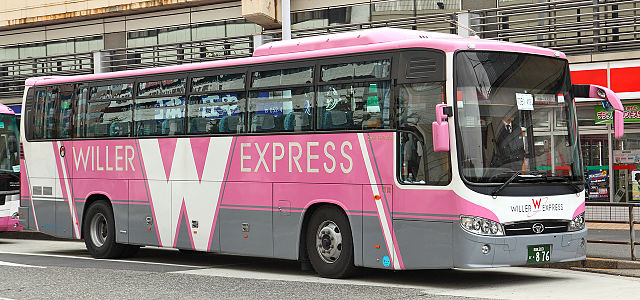
Willer Express, one of Japan’s major highway bus operators, is distinguishable by their pink and white buses. They offer varying bus routes across Japan with fares depending on the day and the class of seating offered – by my count there are 17 different seating combinations, including options with and without toilets!

The Willer Express bus pass has gone up in price since its introduction a few years ago, from 8,000 and 10,000 yen for 3 and 5 day bus passes, respectively, to 10,000 yen for the 3 day version and 15,000 yen for the 5 day version.

There are a list of travel conditions to use the pass, the important ones being:

– You must be a foreigner visiting Japan with the “Temporary Visitor” stamp… every time you board a bus you will need to show your bus reservation, bus pass and passport.
– Once issued, you can take trips on Willer Express buses on any 3 or 5 days in a two month period. They do not need to be consecutive days.
– You are permitted to take a maximum of two daytime buses and one overnight bus every day. Overnight buses that leave after midnight count for the previous day.
– If making connections for same day travel you must allow at least one hour’s connection time.
– Passes are not valid for the more expensive seating options.
– You cannot use the bus pass for travel during the New Year’s holiday (December 26 – January 4)

It’s a good deal if you plan to hit a few major cities. The more trips you take on the pass on one travel day, the more cost-effective it will be. Technically speaking you can take a maximum of 9 trips on the 3 day pass, and 15 trips on the 5 day pass (3 trips per day in both instances) which could lower your per-trip cost to between 1,000 and 1,100 yen. Even if you end up taking two trips per day, you still stand to pay only 1,700 yen per trip with a 3 day pass or 1,500 yen per trip with a 5 day pass – what a bargain! If you take one trip per day, it’s 3,300 yen per trip on a 3 day pass or 3,000 yen per trip with a 5 day pass.

Willer’s web site has a page that lists off model itineraries. But you know me, I love experimenting the possibilities. Let’s see what we can do!

JOSE’S MODEL 3-DAY BUS PASS ITINERARY

We’ll start in Tokyo on Day 1 and depart from Willer’s own bus terminal located west of Shinjuku station. First stop: Niigata, on the northern coast of Japan, known for its rice and sake production. Savor the sights and taste some local flavor. When you’re finished, travel to Osaka or Kyoto using either the direct overnight bus, or by changing in Tokyo (which will count as your second daytime bus and your overnight bus).

After you’ve spent some time in the Kansai region, use Day 2 to take an early-morning bus from Kyoto or Osaka to Hiroshima. Spend the afternoon and evening in the city that unfortunately is known for its fate in the second World War. Return by overnight bus back to Tokyo.

On the final day of your pass travel, head for the city of Sendai, a major city located within close vicinity of the Pacific Ocean and a city of rejuvenation following the 2011 natural disaster. Spend the afternoon in Sendai, perhaps wandering over to tour Matsushima, one of Japan’s most important sites (which also largely survived). Return to Tokyo by overnight bus on your final journey, arriving early in the morning.

10,000 yen / 6 trips: just under 1,700 yen for each trip. If you end up taking three buses on Day 1 as in the example, the cost becomes slightly over 1,400 yen per trip.

If you are on a tight budget, and don’t mind spending lots of time on the bus, the Japan Bus Pass is for you. On the other hand, if you’re not in Japan for long, then you might want to spend more time sightseeing than traveling, in which case you’ll want to shoot for faster travel options such as the Japan Rail Pass, or perhaps one of the airplane passes offered by JAL or ANA (which I might write up about soon).

Buy your bus pass at willerexpress.com

Toyota car rental specials for Gotemba and Tokai areas

The Gotemba Premium Outlets are part of a national network of nine outlet stores in Japan. There are over 200 stores in the outlets from many popular brands such as Gap and Coach. It’s also in a unique location – not too far away from the foot of Mount Fuji and the historical / touristy Hakone region.

Gotemba Premium Outlets make special offers available to foreigners from their information center – coupons are distributed to those showing non-Japanese passports. Now, Toyota Rent-a-Car, in partnership with Gotemba Premium Outlets, is offering special tourist rates on rental cars from certain locations. These include the rental stations outside of the Tokaido Shinkansen bullet train stops at Mishima and Shin-Fuji, as well as the JR station in Gotemba. These are ideally situated for those who want to drive to certain areas that are out of reach, or just want the convenience of a car to go to areas such as the Gotemba outlets, Mount Fuji or Hakone.

As a sample, a 6-hour rental of a standard car goes for around 6,000 yen, while a full day’s rental goes for around 8,000 yen. Of course larger and more luxurious vehicles will cost extra. They are also offering a 10% discount off of all of these rates by printing a coupon from the Gotemba Premium Outlets website. Just click on the “Rent a car plan” graphic. 

Of course, not only do you have to consider the expenses for renting a car, you must also adhere to Japanese traffic laws and you must have a drivers license recognized in Japan. Fortunately, the official English web site for Toyota Rent-a-Car explains a lot if you are interested in a car rental. Also you must keep in mind that a reservation must be made by telephone – presumably the “Toll Free” number listed on their web site is for reservations in English, and they take reservations 7 days a week from 7 AM to 7 PM *Japan Time*. Which means for us in North America, an evening or early morning call to make the reservation.

One of the things that is offered in the Gotemba Premium Outlets offer, according to their brochure, is a free ETC card rental. ETC is Electronic Toll Collection which is used on Japan’s major highways. It’s the EZPass, TollTag and FasTrak of Japan, basically. The toll charges are lower than cash, and presumably any charges are placed on your final bill. Also, a GPS device which can operate in English is available to use.

The 24 hour rental seems to be a good deal if you will be visiting any areas around Fuji, Hakone or Gotemba, or visiting/staying at any surrounding areas that might be out of reach. For example, know of a good onsen near Mishima that you want to visit? If it’s nowhere near public transit, driving a car there may be beneficial. 

Yes, you can use the Nozomi with a pass (but not the pass you are thinking)

Some news to come out of Japan tourism in the last few days is the availability of new rail passes to foreign tourists. Both are offered by JR Central and JR West, which operate the main bullet train lines in Japan.

The first pass is the Tokaido / Sanyo Shinkansen Tourist Pass. This pass permits unlimited travel on ANY bullet train service between Tokyo, Nagoya, Kyoto, Osaka, Okayama, Hiroshima and Fukuoka (Hakata) station for 5 consecutive days at a cost of 35,000 yen. I said ANY because this pass allows the use of the faster Nozomi and Mizuho trains that the Japan Rail Pass does not permit. The pass also includes travel on selected non-shinkansen routes, including unlimited use of local JR lines in Osaka City, access to the Okayama Tramway, access to a bus service to the foot of Mount Fuji, and free admission to certain museums like the JR Central Transit Museum, aka SCMAGLEV and Rail Park. You can also make up to four seat reservations with the pass on any bullet train service offering reserved seating.

The second pass is the Takayama / Hokuriku Area Tourist Pass, which permits unlimited travel on the “limited express” or premium train services between Osaka, Kyoto and Kanazawa, or Nagoya and Takayama, as well as bus service from Takayama to Kanazawa via Shirakawa-go, the world heritage site. Like the Tokaido / Sanyo tourist pass, it is also valid for 5 consecutive days. The Takayama / Hokuriku Area pass costs 10,500 yen. You can also a local bus in Takayama City, the “Sarubobo” bus service.

I think that the Takayama / Hokuriku pass is a good deal for 10,500 yen if you intend to travel specifically to Takayama or Shirakawa. The Tokaido / Sanyo pass, on the other hand, is NOT a good deal in my opinion. Consider that the 5 day Tokaido/Sanyo pass costs 35,000 yen and only offers up to 4 reserved seats in 5 days, while the national Japan Rail Pass costs a little over 29,000 yen in standard class for 7 days and you can make unlimited seat reservations in that time frame. With the costs of traveling around Osaka pretty marginal – and with plenty of subway lines to bring you around Osaka anyway – the Japan Rail Pass – even if it does not offer the ability to travel on the faster trains – is a cheaper and better offer. The only difference is if you want to use the Tokaido / Sanyo pass to gain access to the additional sightseeing areas or routes that are offered.

To book any of these passes you must contact a travel agency in your home country that offers the pass – just like you would with the national rail pass – and purchase an exchange order that is then traded in for the real pass in Japan. Also, the passes are only offered from October 1 until June 30, 2015.

You can download brochures for these passes at touristpass.jp

Autumn Fare Sale for flights from New York, Houston and Washington to Japan

One of the most difficult aspects – and one of the biggest expenses – of a trip to Japan is the airfare. Right now (April 14, 2014) the round-trip airfares from New York, for example, are a staggering $1,500 per person. So it helps to occasionally do some research to see if there are any good airfare deals.

I stumbled upon a few cheap airfares that are worth mentioning if you are interested in making plans to visit Japan in the fall.

First is a fare sale that Air China (Star Alliance carrier) is having on its flights to Beijing from Houston-Intercontinental and Washington-Dulles, which then extends to connecting flights operating out of Beijing to Tokyo and Osaka. I am guessing these fares are on sale because they are relatively new air routes. If you don’t mind a longer trip (18-19 hours or so each way) and an evening arrival in Japan then you may want to look at what they are offering.

The second cheap airfare is something I’ve mentioned before – it’s the service from China Airlines (Skyteam carrier) that operates from New York-JFK nonstop to Osaka-Kansai three times a week, as part of its route that continues to Taiwan. While Air China also offers a similar fare sale from New York to Tokyo and Osaka via Beijing, China Airlines’ nonstop to Osaka is, in my opinion, the better and less time consuming deal.

Before continuing, a reminder that these airfares were researched independently by myself on April 14, 2014 and the expiration date for sales is not known. Information provided is for use at your own risk and subject to the Jose’s Japan Tips Disclaimer.

NEW YORK TO OSAKA KANSAI (Nonstop on China Airlines)
$1,111 round/trip including taxes and fees.
The fare is valid for outbound travel from September 15 through November 22 and requires a minimum stay of 6 nights in Japan. Maximum stay is 30 days or returning on November 29, 2014, whichever is sooner. Travel between New York and Osaka operates on Mondays, Thursdays and Saturdays in both directions. There is a free checked baggage allowance of two bags per person.

HOUSTON TO TOKYO HANEDA/NARITA (via Beijing on Air China)
$909 round/trip including taxes and fees.
As the Houston to Beijing flight is a redeye (leaving 1 AM and arriving 4:50 AM), you can choose a flight to either Haneda or Narita airport. The flight to Haneda is recommended since it arrives one hour sooner than the flight to Narita (12:50 PM vs 1:55 PM), and because Haneda is closer to Tokyo than Narita.

HOUSTON TO OSAKA KANSAI (via Beijing on Air China)
$913 round/trip including taxes and fees.

WASHINGTON, DC TO TOKYO HANEDA/NARITA (via Beijing on Air China)
$1,051 round/trip including taxes and fees.
The flight from Washington requires an overnight layover in Beijing, yielding an arrival in Japan two days later. You can choose a connecting flight to either Haneda or Narita airport. The flight to Haneda is recommended since it arrives one hour sooner than the flight to Narita (12:50 PM vs 1:55 PM), and because Haneda is closer to Tokyo than Narita. On the return trip the layover in Beijing is only 1 1/2 hours.

WASHINGTON, DC TO OSAKA KANSAI (via Beijing on Air China)
$1,054 round/trip including taxes and fees.

All of the AIR CHINA FLIGHTS are valid for outbound travel from September 5 through December 8, with a few blackout dates (more from Washington than Houston). The maximum stay is 30 days or returning on December 31, 2014, whichever is sooner. With Air China there is a free checked baggage allowance of two bags per person.

No matter how long your layover, Beijing has a transit visa waiver for passengers staying in the airport and connecting to another flight within 24 hours. When transiting in Beijing you will have to go through border inspection for your transfer, followed by a security checkpoint.

There is also a 72-hour transit visa waiver for citizens of over 50 countries, including the US and Canada, who stop and sightsee in Beijing en route to a destination outside of China.

Of course, if you live on the West Coast of the US, the flights are pretty competitive, with nonstop flights in the fall – particularly on ANA, as well as Singapore from Los Angeles – going for about $1,000 round/trip. 🙂

I hope this information helps you if you decide to go and experience the wonderful country of Japan in a few months!

Suica & N’EX package for tourists to be retired on April 1st

A note to foreign travelers to Japan that JR East’s “Suica & N’EX” package that had been sold for the last few years will be discontinued on April 1st, with the final sales taking place on March 31st. The “Suica and N’EX” package allowed tourists to travel on the Narita Express from Narita Airport to Tokyo and receive a SUICA card for travel around the Tokyo area at a reduced fare. One-way and round trip packages, as well as standard and green (first) class accommodations were all available. However, JR East has decided to retire this option. My guess is either due to low use or because of the pending increase in the consumption (aka sales) tax in Japan.

In any case, JR East is now pushing it’s one-way “N’EX Tokyo Direct Ticket” which is a flat 1,500 yen fare in standard class from Narita Airport to stations in Tokyo. The new package does not include a Suica card, does not include a round-trip (the return fare has to be paid in full), and does not include Green Car accommodation (which also has to be paid in full).

More details on the JR East Web Site: http://www.jreast.co.jp/e/pass/nex_oneway.html

Japan sales tax increasing on April 1st

This is a short post to remind people traveling to Japan that the Japanese consumption tax, otherwise known as ‘sales tax’ or ‘GST’, will be increasing from 5% to 8% on April 1st. Everything and anything sold in Japan will go up in price slightly, from train and bus fares to convenience store products and lodging.

In most metropolitan areas, actual fares are rounded up to the nearest 10 yen. This practice will continue, though in Tokyo some of the major transit companies, including the subways and JR East, will introduce a special fare structure for those using contact-less IC cards (such as Suica and Pasmo) that round fares up to the nearest 1 yen, as they say this will more accurately reflect the new prices. This means that fares paid with IC cards will be slightly cheaper than paying with regular paper tickets.

For the casual tourist this may not be much, but continue using public transit frequently and the new savings will become more apparent.

Of course you could use a Japan Rail Pass… but of course, the consumption tax will be raising THOSE prices on April 1st as well. For example a 7-day ordinary rail pass for the Japan Railways will increase from 28,300 yen to 29,110 yen, while a 14-day ordinary pass goes up from 45,100 yen to 46,390 yen.

JR East has published some information in English, which can be viewed on their website, http://www.jreast.co.jp/e/

On a side note, I am hoping to continue sharing my Japan Diary soon. I’ve been swamped lately with marriage preparations 😦 Thanks for being patient!

First Post in 2014…

Good grief am I behind 😛

Well greetings to my first post of 2014. There have been so many events in my life, personally and professionally, over the last several months that I haven’t had the chance to write anything here. Hopefully that will change soon.

Oh and something else happened since my last post. I WENT TO JAPAN!

I did write some daily updates from my trip last September on my personal Facebook page, so perhaps the best thing for me to do is just copy these over for everyone to look at.

In the last few days I heard from a man named Dave, who discovered my blog and asked me questions about a potential trip to Japan later in the year. I was happy to help him out!

Hopefully I’ll review what I have here, make any updates to posts where required, and start sharing my trip journals shortly.

If you’ve read through the blog and have any questions about your trip, please ask and I’ll be happy to help you out the best that I can.

Until next time!

Japan by Bus… why Willer Express looks more promising for English reservations

I’ve mentioned on this blog before about bus travel in Japan, including a sample fare breakdown on my (not sure why) popular post, Tokyo to Kyoto for 2,300 yen.

Lately, though, I’ve been noticing that the JR bus lines, whose main routes are prominently featured on a specific website (Japanese only), are offering different fares for different dates. To me, it’s a whole lot of confusion, especially when trying to plot trip budgets.

Perhaps this blog post is more of a vent, but here goes:

In the past, there used to be only one flat fare for certain buses, or two fares depending on the day of the week that the bus would depart. Now, many JR buses – in particular those traveling the heavy-trafficked route between Tokyo and Kansai – are offering…. ELEVEN different fare structures??

Case in point: Here is the web page for the Tokyo to Kansai bus route offerings. They used to list the fares prominently on this page… but this is no longer the case.

Clicking through to the standard overnight bus offering, the “Dream”, there is a section way at the bottom of the page where you click to see the fares… now listed in a PDF file.

A sample of the different fare structures for JR Bus' "Dream" taken from their website.
A sample of the different fare structures for JR Bus’ “Dream” taken from their website.

And there you see the calendar… with different colors for different days of the week. I’ve included a snapshot here to list an example. Upon looking below at the fare chart, there are ELEVEN different colors – that’s eleven different fare structures – ranging from red, the most expensive, all the way down to blue.

Red is reserved for high-demand travel days. In the example shown, there are some days in August marked in red that center around the Obon travel holiday. These have the most expensive fares – 8,800 yen from Tokyo to Osaka, for example – and they do NOT offer discounts for advanced purchases. Next on the scale is pink, which on the calendar is marked on the week falling between the two red weekends in August. Now the fare is slightly lower at 8,600 yen, with a discounted fare of 8,000 yen for a 5-day advanced purchase.

The lowest fare on the calendar is the cream color… which can only be had on most weekdays in July, and a few weekdays in the last week of September. Now it’s only 7,200 yen for a Tokyo-Osaka trip. A 5 day advanced purchase runs 6,000 yen, and a 3 day advance is also offered for 6,300 yen.

Those are the facts… but it’ll all be a moot point when I say that you can’t do an online booking for JR buses in English anyway.

You can book seats on buses when you get to Japan… Either at a bus station or even at a JR railway station (green reservation counter)… but if you want to book a trip on a bus before you get there, Willer Express is now turning out to be the clear-cut willer… er, winner.

Willer Express bus. Photo by Wiki user Tennen-Gas, CC BY-SA 3.0

Willer Express’ website for English bus reservations is extremely easy to use, and I believe they are making a special commitment to accommodate non-Japanese passengers – especially with their Japan Bus Pass option that allows 3 days worth of bus travel for 10,000 yen or 5 days for 15,000 yen. Willer Express also has a lot of different seating types to choose from, not just the three or four seating types found on the JR bus lines – but these seats are clearly described for you on the site.

Just one caveat with Willer is that you are not allowed to request a certain seat assignment… window, aisle, or anything of the sort. Willer will assign seats on the date of departure based on the number of passengers in your group, and believe it or not, the gender as well. Willer will not seat men together with women unless they are in the same party.

But of course, the main point…. prices are clearly listed on the site for your intended date of travel.

Willer Express comes out on top in these categories, and I recommend that you check them out when it comes to long-distance budget travel in the country.