New Mobile Ticketing for Shinkansen arriving next year

This afternoon I came across a press release from the Shinkansen timetable site Tabi-O-Ji, and I thought it might be nice to share here on the blog.

If you want to travel by bullet train in Japan, under most circumstances you cannot book your ticket until you arrive in Japan. There are a few exceptions, most notably the online reservation system of JR East, allowing travelers to reserve – in English – trips on bullet trains that they operate. While many routes to the north are covered, the most important routes – the Tokaido and San’yo Shinkansen connecting Tokyo to Nagoya, Kyoto, Osaka, Hiroshima, Fukuoka and points in between – does not offer advance ticketing in English.

This MIGHT change in the Summer of 2017, when JR Central and JR West are set to unveil a new mobile ticketing system for Tokaido and San’yo Shinkansen trains. According to the press release, you will be able to use the new ticketing system by linking your credit card and an IC card, such as a SUICA, TOICA, ICOCA, etc. You’d have to pick up an IC card in Japan if you don’t have one already, but once you have one you can add it to the account.

Purchases in the new system would be charged to your credit card, then when you are ready to travel you simply tap in and out of the ticket barriers using your IC card.

I bring this up because apparently there is some language in the JR press release saying that “Even foreign travelers can use the system”. This might suggest that in the future, there could be an English option to purchase shinkansen tickets on the Tokaido and San’yo Shinkansen using a mobile device.

There are a few points to note:
– As the release says, you must be in possession of an IC card BEFORE you make a purchase. If you have acquired an IC card from a previous trip to Japan, it is valid for five years after purchase.
– There is no option mentioned regarding purchases for Japan Rail Pass holders. I honestly do not expect such an option to be made available – instead, rail pass holders would have to continue making ticket reservations in person, and pass through manned ticket barriers to access trains.

Further details are yet to be announced (including whether or not there will be an English option) but if you plan to go around on the Tokaido and San’yo Shinkansen using regular tickets, the new mobile ticketing system that will be in place next year might just make purchases easier.

Hokkaido Travel Notice – March 22-25

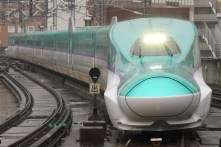
H5 shinkansen
H5 series Shinkansen on a test run. By Sukhoi37, CC BY-SA 4.0

With roughly one month to go until Japan’s iconic bullet train enters the northern island of Hokkaido for the fist time, here’s an important travel advisory for potential visitors to Hokkaido.

Between March 22 and 25, train services from the Japanese mainland to Hokkaido will be shut down in order to make final preparations for bullet train services. This means that during this four-day period, the only way to travel into and out of Hokkaido is by airplane, or by ferry to one of the northernmost ports in Honshu (i.e. Aomori).

The Seikan Tunnel is the long, 33 1/2 mile tunnel connecting Hokkaido with the Japanese mainland under the Tsugaru Strait. Since 1988, passenger trains have made the journey through this tunnel on journeys to and from the southern Hokkaido city of Hakodate. Considering the amount of freight traffic that also uses the tunnel, the Seikan Tunnel is one of the country’s most vital transportation links.

During the four day period that the tunnel is closed, construction crews will make final preparations for the introduction of the new shinkansen services. One of these steps is to raise the overhead voltage into the tunnel from 20 kV to the shinkansen standard of 25 kV.

When the Seikan Tunnel opens to Shinkansen traffic on 26 March, the vital freight services will resume operation. Naturally, JR is on top of things – two years ago, it introduced a new electric locomotive, the EH800, capable of operating at both 20 kV and 25 kV. It will be the sole locomotive hauling freight through the tunnel moving forward.

The opening of the Shinkansen stands to revitalize Hakodate – and in turn, Hokkaido – with new visitors. In the meantime, if you are planning a trip to Japan in the next month, please take note of these dates when the Seikan Tunnel will be closed.

Airfares to Japan on Sale

THIS SALE IS NOW OVER 😦

Normally I reserve airfare updates to Japan for my Facebook page, but I thought I would let everyone know here that there is a major price war for flights between the United States and Japan, now involving all three of the major U.S. Carriers: American, Delta and United. Many cities now offer discounted flights to Japan from between $550 and $650 round-trip. Some markets are excluded at the moment (i.e. Atlanta, New York) but do be sure to check out the websites of these airlines to snag your tickets NOW. (That’s my opinion anyway!)

Fares are good for travel for most dates in March and April.

Haneda Airport to be opened to daytime arrivals for U.S. airlines

This week, the governments of Japan and the United States reached an agreement with regards to U.S.-based airlines  flying into Haneda, the closest airport to Tokyo.

A few years back, U.S. airlines were permitted four daily round-trips from U.S. cities to Haneda, but these flights were restricted to evening hours, when the airport is not busy… and close to the times that public transportation options become limited. This could have proved to be a headache, as I suggested back in 2011, though the opening of a hotel within Haneda’s International terminal in 2014 eased the travel worries somewhat.

Under the new agreement, however, U.S. airlines will be permitted to land at Haneda during regular daytime hours. The slots will change from four round-trips during the night hours to five round-trips during the day, and one round-trip during the evening. The changes will be implemented as early as this coming autumn.

This is tremendous news for travelers between the United States and Japan, as you can now enjoy all of the amenities that Haneda has to offer, while being able to travel into Tokyo quickly and cheaply by train or monorail.

Two of the three major U.S. airlines – American and United – support this agreement. Delta Air Lines, on the other hand, opposes it. Delta feels that the slot change at Haneda to permit more U.S. arrivals during the daytime could compromise its hub operations at Narita Airport and put its U.S.-Japan flights into jeopardy, since travelers would prefer to land at Haneda.

One other aspect that tilts against Delta is the fact that American and United have partners in Japan: American partners with Japan Airlines in the Oneworld alliance, and United partners with All Nippon in the Star Alliance. With Haneda Airport offering plenty of domestic flights from its two domestic terminals, there is an opportunity for US travelers to easily connect between international and domestic flights. In fact, Japan Airlines already offers easy International-to-Domestic connections from the International Terminal building – once you clear customs and immigration and drop off your baggage, you clear security in the International terminal and then board a bus to the secure area of the JAL domestic terminal.

In my opinion, this is a win for travelers who now have better ways to see Japan through the new daytime arrivals and departures at Haneda. What are your thoughts?

JR unveils Tateyama Kurobe Option Ticket

Today Japan Railways (specifically, JR East and JR West) have unveiled a brand new ‘option’ ticket for those who want to take a scenic journey through the Japanese Alps and Mount Tateyama.

This is called the Tateyama Kurobe Option Ticket and will be sold from April 16 to November 9 of this year. The cost is 9,000 yen, and covers a ONE-WAY journey between Nagano and Toyama via the Tateyama Kurobe Alpine Route. You may use the ticket for up to five consecutive days.

Technically the ticket is being marketed towards foreign tourists with some sort of JR Rail Pass (including the Hokuriku Arch Pass, marketed by JR East and JR West), but reading the fine print it appears any foreign tourist with temporary visitor status – i.e., “tourist” – can purchase it.

Note that it takes around 6 – 7 hours to make the one way journey through the area, NOT including transfers, rest stops and congestion delays, so if you’re considering this trip it would probably be wise to make a day out of it. For example, if you are leaving from Tokyo to travel the Tateyama Kurobe route, you’d best spend your evening in Toyama or Kanazawa (nearby on the Hokuriku Shinkansen) before continuing on your next adventure. Or, to make it easier, you can try to find accommodations along the alpine route itself… remember, you can travel one-way on the route for up to five consecutive days.

A variety of trains, buses, trolleys, ropeways and cable cars are used on the entire journey. The highest point of the trip is the bus ride underneath Mount Tateyama; the elevation at Murodo, one of the stops, is 2,450 meters or just over 8,000 feet!

To learn more about the Tateyama Kurobe Option Ticket, visit this website.

To learn more about the alpine route itself, visit this website. One tip if you’d like to plan your journey is to look at the calendar of waiting times, which indicates the days that the journey is likely to be very busy (as of this post, the 2015 dates are shown, but this will give you some sort of idea).

New J-Trip Plan Show on NHK World

jtripplanToday I watched the pilot episode of J-Trip Plan, a brand new Japan travel planning program on NHK World. Hosted by Thane Camus (a fellow New Yorker!) and Amy Ota, J-Trip Plan offers suggestions and tips for Japan travel. The focus of the pilot episode was Winter, with looks at the Sapporo Snow Festival, the Hadaka Matsuri in Okayama, and food tours in Kyoto Prefecture with one segment focused on crab.

The show will be airing once every two weeks from April, and the pilot episode is available for free viewing on NHK World’s VOD service until February 11.

To view the episode: http://www3.nhk.or.jp/nhkworld/en/vod/jtrip-plan/20160129.html

To visit the show’s Facebook page: https://www.facebook.com/NHKjtripplan

I highly recommend NHK’s newest program, J-Trip Plan, and I hope you’ll use the show as one of your guides to plot your next Japan itinerary!