Welcome to the occasional update of my Japan Tips blog, this one starting with wonderful news!
My girlfriend and I have booked our air tickets to Japan for this September! It is the third trip for me, and the first trip for her. We are both excited about the opportunity, and I hope to perhaps provide regular updates here as best I can during the trip.
We’ve decided – since the airfare would be a difference of only $10 – to do an OPEN JAW itinerary. We will land in Nagoya, Japan (one of Japan’s newest International airports) and then fly out of Tokyo Narita about two weeks later. We’ll spend the first few days around Kansai, mostly Kyoto, and then move on to Tokyo from there. We’ve got a lot to plan out… how to go about, what to do, and most importantly, who to see (we have a lot of friends living in Japan!)
There’s still 4+ months to decide, of course…
So there is good news, and unfortunately some sad news, which I will point out in another post shortly… and here it is.
Happy March, everyone. I wanted to quickly pass along some news regarding the Japan Rail Pass. I first discovered this change a few days ago: One of the benefits of using the Japan Rail Pass has been, for some reason or another, the utilization of JR highway buses. That will now be coming to an end, however: Effective with Rail Passes issued on or after April 1 (which is traditionally the start of the new fiscal and school year in Japan), the Japan Rail Pass can no longer be used on any highway bus service. It will still be valid for LOCAL buses that are operated by JR, but not for the highway buses.
The condition as currently stated on the Rail Pass’ official web page refers to “Express buses” being discontinued from pass validity. That term is somewhat confusing, however two other sources that I wrote to confirmed to me that this likely means highway buses.
The discontinuation of this provision likely means two things: Not enough Rail Pass users are using highway buses (why would you when you can take the train), AND/OR more people are perhaps using the Japan Bus Pass offered by Willer Express for their highway bus travel.
Of course, I am still rooting for the day that we can use Nozomi and Mizuho shinkansen trains with the Japan Rail Pass, but much to my chagrin (and my expectation) this restriction will remain in effect. 😦
If you are interested in making a day trip out of Tokyo to some great destinations, a great method of doing so is by the private Odakyu railway. With trains mostly running out of Shinjuku station, Odakyu trains serve the hot springs of Hakone and the seaside of Enoshima. Some trains also connect to the city of Gotemba, which is home to a large outlet shopping mall, and trains also go out to a residential and retailing district called “Tama New Town”.
One of the keys to inviting foreigners to utilize the services of Japanese companies – whether it be a hotel, a restaurant, or travel – is to have a good foreign language website. I believe that the Odakyu Railway has done just that with the upgrade of their new multi-language Odakyu web site, which occurred this month. The website for the English version is at www.odakyu.jp/english ; they also have the new website in Korean and two Chinese languages.
Screenshot of the new Odakyu English web site.
The new slogan for the Odakyu Railway is “Odakyu Has A Japan”, and the new website shows this perfectly. Here are some of the great features of the website:
HOW TO PURCHASE A TICKET: The website shows how you can purchase any Odakyu ticket from one of their vending machines. Most Odakyu ticket vending machines have an English option. You can purchase a standard ticket, a ticket for their premium “Romancecar” trains, and even purchase an Odakyu Free Pass for unlimited travel in whatever region you are visiting. My favorite part is the one that shows you how to snare the lucrative window seats – either seats facing towards the front or towards the rear – on the trains where the driver sits in the high cab. These are great seats for a panoramic view of all of the action – and it’s available at no extra charge.
HOW TO NAVIGATE SHINJUKU STATION: Shinjuku Station is recognized by Guinness as the busiest train station in the world, with over 3 million people using it every day. It is also a place where one can easily get lost if not paying attention. Odakyu’s website shows you how to get around Shinjuku Station and how to access the Odakyu Railway from other train lines serving the station.
HOW TO TAKE TRAINS: The new Odakyu website gives a detailed description of each of its train services, from Romance Car to regular commuter trains, Express to Local and everything in between. It also shows you how to travel on these trains and the manners you should follow as well.
ODAKYU RAIL PASSES: This gives you a breakdown of all of the Odakyu Rail Passes that can be purchased, and the areas covered.
SIGHTSEEING GUIDE AND ITINERARIES: A comprehensive review of the major destinations served by the Odakyu Trains, and suggested day trip courses are provided. Interestingly enough, one of the reviews provided is of Shinjuku. A hint: Each of the major destinations served by Odakyu is accompanied by a brief video presentation (linked to YouTube). Maximize your screen and get ready to enjoy sneak peeks at what is in store for you.
With all of the positive enthusiasm of my post, you might think that Odakyu was behind this posting. Trust me, Odakyu has nothing to do with it. I am just amazed at how much information is available on the new website in a way that is very easy to understand. I highly recommend using the website if you are considering future trips to Tokyo, especially since using Odakyu trains tend to be on the cheap side, compared to the Japan Railways which will be more expensive.
One more note on this subject: Once you are in Japan, feel free to visit the Odakyu Sightseeing Service Centers located at the major stations, including Shinjuku. They have staff in English that can answer your questions about travel on Odakyu, sell you rail passes and sell you tickets on the Romancecar trains.
Now that I have sung the praises of Odakyu, here is a breakdown of some of their most popular rail passes.
HAKONE FREE PASS: Most tourists to Japan will probably take advantage of this pass. The Hakone Free Pass is a benefit when visiting the Hakone region, famous for its hot springs and history, not to mention its close proximity to Mount Fuji. The pass is available in 2-day consecutive and 3-day consecutive versions and includes unlimited transportation of Odakyu trains between Odawara and Hakone-Yumoto, most trains, trams, cable cars and buses that serve the area, and the primary sightseeing ship that crosses Lake Ashi. I might have already written more about the Hakone Round Trip Course somewhere in my blog… AHA! Here it is. If you’d like more information about Hakone, please read that post. The pass also includes discounts at many shops located in the Hakone region – whichever shows the Hakone Free Pass logo on the store front will offer some sort of discount to you.
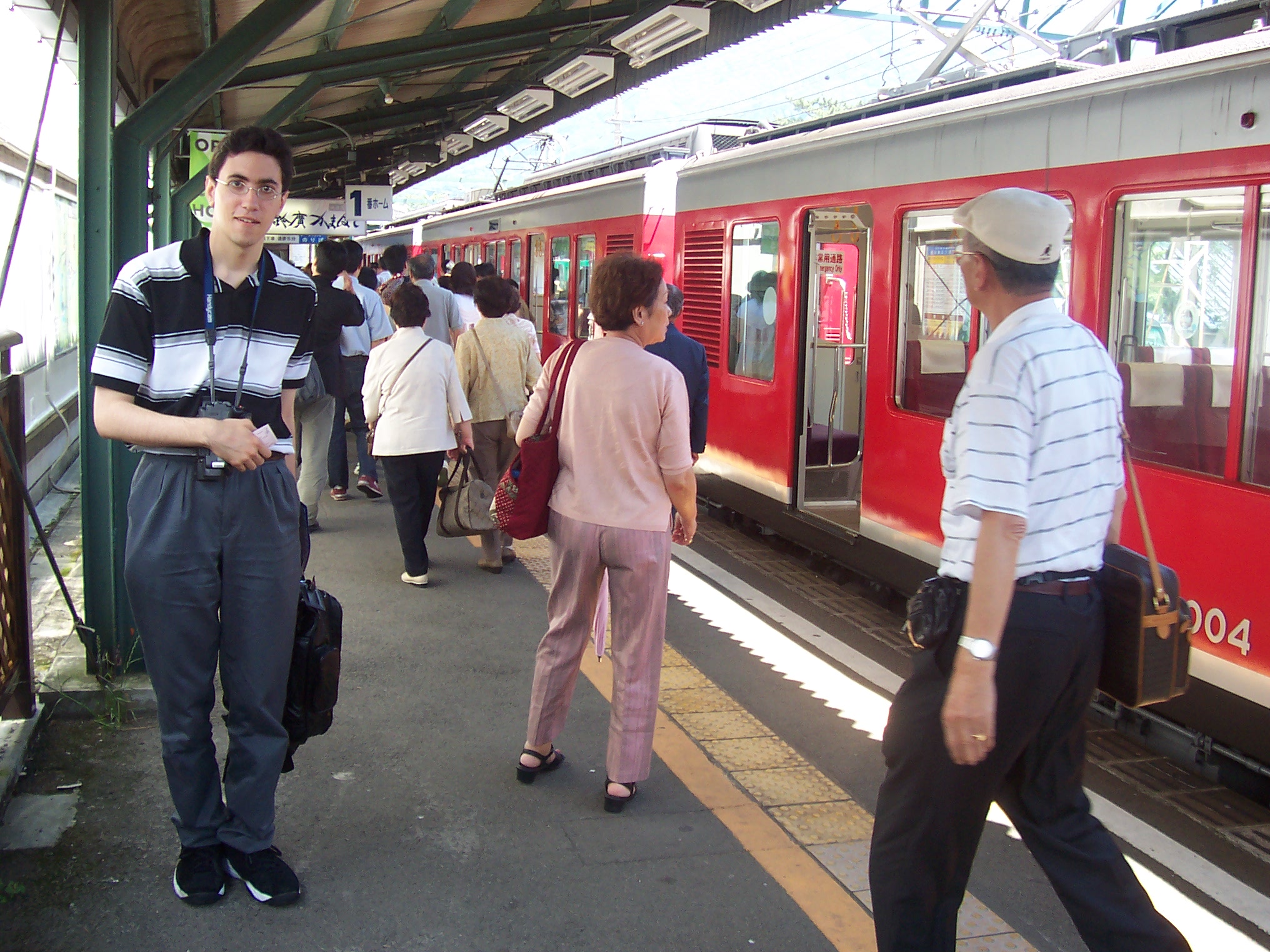
Jose stands next to the Hakone Tozan train in Gora. Photo by Jose Ramos, June 2004
The Hakone Free Pass for adults starting from Odawara costs 3,900 yen for 2 consecutive days, and 4,400 yen for 3 consecutive days. The pass from Shinjuku station costs 5,000 yen for 2 days and 5,500 yen for 3 days. The difference is that the pass that starts from Shinjuku includes ONE round-trip on the Odakyu Railway’s standard commuter services between Shinjuku and Odawara.
A trip from Shinjuku to Hakone-Yumoto on standard Odakyu trains takes about 2 hours or so, and you will need to change trains at Odawara one way or the other. On the other hand, a trip on the premium Romancecar service is 20-30 minutes faster, not to mention it’s easier and more relaxing with reserved seating, wagon cart or vending machine service on most trains, and if you’re lucky – as I mentioned earlier – a wide view of all of the action from the front of the train. A trip on the Romancecar is NOT INCLUDED in this pass or ANY Odakyu Rail Pass – you will need to pay the surcharge in addition to the pass. For a trip between Shinjuku and Hakone-Yumoto, the surcharge is 870 yen per person each way.
There is also an option to start your trip from Odawara. When to consider this? Simply put, if you have a Japan Rail Pass… with your Japan Rail Pass you can access Odawara – which is also a Japan Railways station – at no charge before proceeding to Hakone-Yumoto. Here’s a thought – Odawara is also a bullet train stop, so you can use a twice-hourly Kodama service from Tokyo or Shinagawa and reach Odawara in no time… only 27 minutes from Shinagawa, normally costing around 3,400 yen or so on its own, and at no charge if you use a Japan Rail Pass. What’s more, if you wanted to you could travel from Tokyo to Odawara by bullet train, do your trip in Hakone with the Free Pass, then when the day is done return to Odawara and continue right on using the bullet train… in the evenings you can leave Odawara on a Kodama, change trains along the way and be in Kyoto in just three hours!
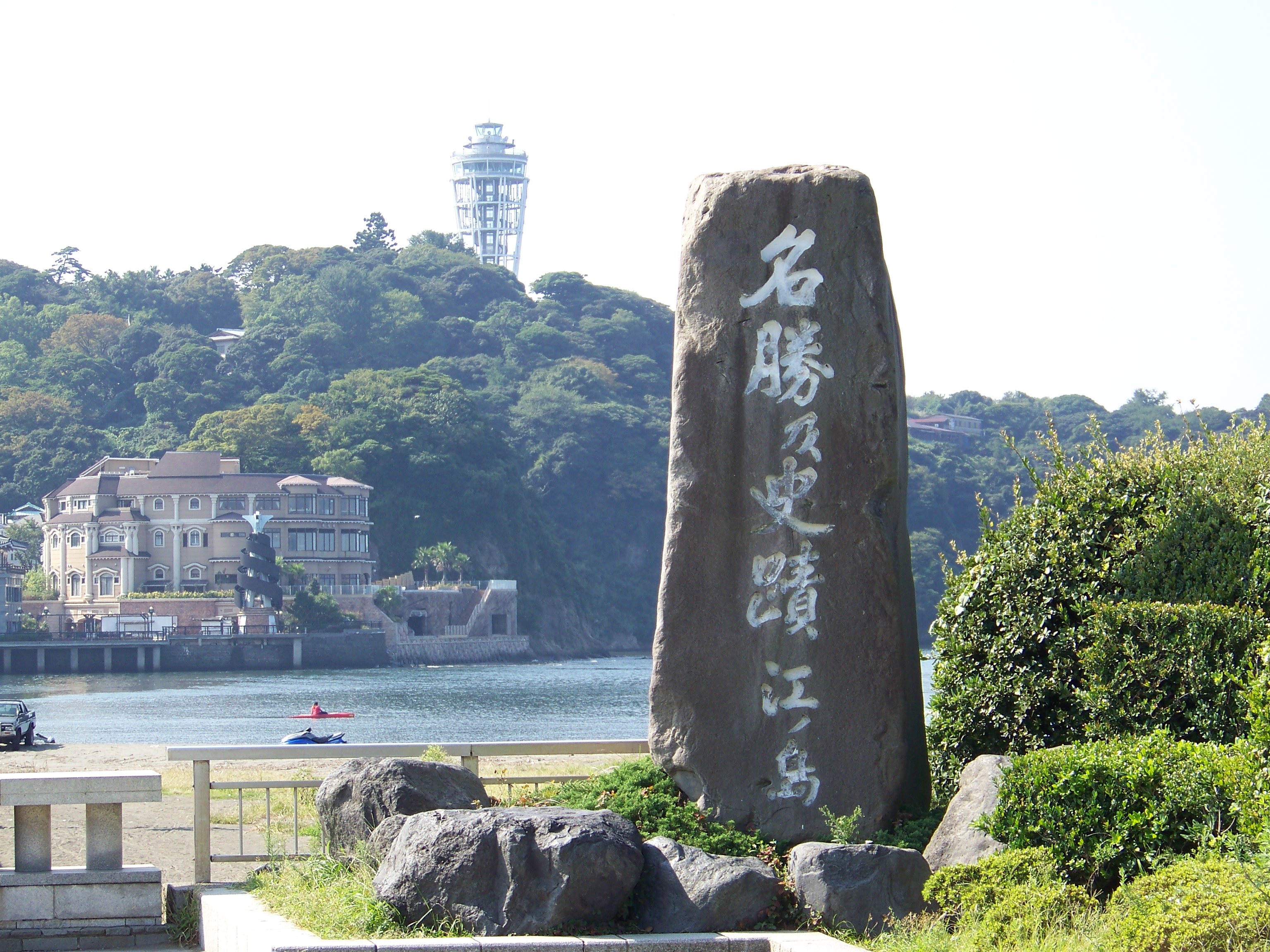
The entrance to Enoshima island is prefaced with this stone marker. Photo by Jose Ramos, October 2008
ENOSHIMA ONE-DAY PASSPORT: For those wanting to explore the island of Enoshima and the seaside, this one day pass is an option. Selling for 1,940 yen per adult from Shinjuku station, it includes ONE round-trip from Shinjuku to Fujisawa, unlimited Odakyu train travel on the short line running from Fujisawa to Katase-Enoshima (the station on Enoshima closest to the seashore), and admission to Enoshima island’s main attractions, including the Enoshima ESCAR (a series of three escalators that help you get up the island without having to tire your legs walking up regular steps), the Enoshima lighthouse and observatory, and the Samuel Cocking Garden (named for a British merchant who used the location in the late 1800’s for his tropical plant collection). It also includes discounted admission to Enoshima Aquarium.
The Romancecar charge is 600 yen per adult each way. Note that on Weekdays the Romancecar trips are very limited – for example, there is only ONE morning Romancecar trip to Enoshima, departing towards the end of rush hour. On weekends however, there’s a train every one or two hours. The Romancecar gets you from Shinjuku to Enoshima in 60-70 minutes, while commuter trains take 80-90 minutes.
A short walk inland from the shore brings you to the Enoshima Tramway, or ENODEN. This tramway connects to another important destination of religious significance, Kamakura, home to one of Japan’s largest Buddhist statues and the country’s largest Shinto shrine. The Enoshima One-Day Passport does not include any of these destinations; for this you will need:
ENOSHIMA-KAMAKURA FREE PASS: This one day pass costs 1,430 yen from Shinjuku Station and includes ONE Odakyu round-trip from Shinjuku to Fujisawa (Romancecar extra), unlimited Odakyu train travel on the short line running from Fujisawa to Katase-Enoshima, and the entirety of the ENODEN from Fujisawa to Enoshima and Kamakura. Unlike the Enoshima One Day Passport, this free pass does not include admission to the attractions on Enoshima described above, but you can get a discount on those same attractions.
Using this Free Pass you can get off from the ENODEN at Hase and visit the great Buddha of Kamakura (10 minute walk), where many Buddhist worshipers come to pray. At the end of the line in Kamakura, walk 10 minutes to Tsurugaoka Hachimangu Shrine, the largest Shinto shrine in Japan.
Odakyu offers other travel passes, some exclusively to foreigners, including: the Fuji Hakone Pass which combines a trip to Hakone with a visit to Lake Kawaguchi and the foot of Mount Fuji, the Ito-Kanko pass and Minami-Izu pass for visiting the Izu peninsula, home to one of Japan’s famous hot spring areas, and a pass that includes travel and admission to some of Hakone’s favorite hot spring spas. More details about these passes can be found on the Odakyu website.


 Jose's Japan Tips